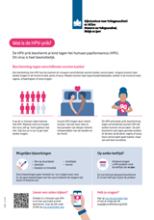
HPV can cause different types of cancer, in both women and men. Vaccination against HPV offers effective protection against these types of cancer. The HPV vaccination is given around the age of 10 years.
HPV vaccination factsheet
| Protects against | different kinds of cancer caused by HPV |
|---|---|
| Given at which age(s)? | In the year that children turn 10 |
| How many vaccinations are needed? | 2, with six months between the first and second vaccination |
| Most common side effects | Pain at the injection site, muscle pain |
| Period of protection | At least 15 years |
| Vaccination since | 2010 |
Children will receive a different HPV vaccine starting in autumn 2026. As requested by the Ministry of Health, Welfare and Sport (VWS), the Health Council of the Netherlands reviewed the effectiveness of the HPV vaccination programme and assessed whether adjustments are needed. The Health Council concluded that HPV vaccination is very effective in preventing HPV infections, cervical cancer and its precancerous stages. To improve effectiveness even more, the Council has advised using a different vaccine from now on: the 9-valent vaccine. State Secretary Thielen then decided to adopt the advisory opinion of the Health Council and switch to a different HPV vaccine.
Difference between the current and upcoming HPV vaccine
The current (2-valent) vaccine offers very effective protection against the two types of HPV that cause most of the HPV-related types of cancer. It also offers partial protection against three other types of HPV that regularly cause cancer. The upcoming vaccine is a 9-valent vaccine that protects against seven types of HPV that can cause cancer, as well as two types of HPV that can cause genital warts.
Is the 9-valent vaccine just as safe as the 2-valent vaccine?
Yes. According to the Health Council, the 9-valent vaccine is just as safe and effective as the 2-valent vaccine.
No need to get a new HPV vaccination after two doses of the 2-valent vaccine
Your children do not need to get a new HPV vaccination if they have already had two doses of the 2-valent vaccine. The current vaccine already offers very effective protection against the types of HPV that are most likely to cause cancer.
When can my child get the 9-valent vaccine?
The 9-valent vaccine will be included in the National Immunisation Programme from September 1, 2026. Until then, the current 2-valent vaccine will be used. The 9-valent vaccine is currently available at your own expense and can be arranged through the GP, the Municipal Public Health Services (GGDs) a vaccination centre.
Is it possible to get the first vaccination with the 2-valent vaccine and the second vaccination with the 9-valent vaccine?
Yes, that is possible. Various studies have been done on this topic. In some countries, this combination is the standard protocol for HPV vaccination. It is safe and offers effective protection against HPV-related cancer. In addition, 1 dose of the 9-valent vaccine also provides good protection against genital warts.
Waiting for the new HPV vaccination?
It is not advisable to postpone the vaccination. The 9-valent HPV vaccine is not currently available through the National Immunisation Programme. With the current 2-valent vaccine, your child has very effective protection against the two types of HPV that cause most of the HPV-related cancers. The 9-valent vaccine offers broader protection (also against genital warts), but that does not remove the current effective protection against HPV-related cancer offered by the 2-valent vaccine. You may want to consider what is most important to you about the HPV vaccination: rapid protection against HPV-related cancer, or additional protection against HPV-related diseases like genital warts? If you postpone, your child will not be protected until after the vaccination. That could involve risks. If you are having difficulty deciding on your own, contact your local Youth Healthcare Services (JGZ) to discuss it.
Protection offered by the HPV vaccine
HPV vaccination protects against long-term HPV infection and cancer (including precancerous cells) resulting from HPV types 16 and 18. In response to the vaccination, the body produces antibodies to the virus. If you are infected with HPV after that, your body will recognise the virus and clean it up on its own. The HPV vaccine works best if you are not already infected with HPV. That is why children are already invited for the HPV vaccination in the year that they turn 10.
HPV vaccination offers around 90% protection against cervical cancer caused by HPV types 16 and 18. This is supported by research. These types of HPV are the most likely to lead to cancer. The vaccination also offers effective protection against other types of cancer caused by HPV.
There are also other types of HPV. The vaccination offers less effective protection against those other types. That is why it is important for women to take part in population screening against cervical cancer after they turn 30. This applies even if they have been vaccinated against HPV.
Steffie: the HPV vaccination in easy language

Steffie explains in easy language how the HPV vaccination works. Available in Dutch, English, Arabic, Ukrainian, Polish and Turkish.
If your child has a fever higher than 38.5 C, it would be better to postpone the vaccination. Consult with your GP or a doctor with the Youth Healthcare Services (JGZ) to reschedule the vaccination for your child.
Yes. Until you reach the age of 18 years, you can be vaccinated for free at a Youth Healthcare Services (JGZ) organisation near you. See our page Appointment for childhood vaccinations for more information. This applies to your HPV vaccinations and all other vaccinations from the National Immunisation Programme. If you still want more information before deciding, you can also contact your local JGZ office to discuss all your questions about vaccination.
No permanent side effects
Possible side effects after the HPV vaccination include a sore arm and muscle pain. Sometimes people may also have stomach pain, nausea, tiredness, headache or fever. This all goes away within 1-3 days. No serious, permanent side effects have ever been found, even though the vaccination has been given in the Netherlands since 2010.
More than 1.5 million people in the Netherlands are now fully vaccinated against HPV. Symptoms that could be side effects are being studied thoroughly. The website of the Pharmacovigilance Centre Lareb has more information about vaccine side effects.
No permanent fatigue symptoms due to HPV vaccination
Some parents are concerned that their child may have long-term fatigue symptoms after the HPV vaccination. Chronic fatigue is not related to the HPV vaccination in any way. Girls who have not been vaccinated are just as likely to suffer from chronic fatigue as girls who have been vaccinated. This is supported by research in the Netherlands, Great Britain and Norway.
The website of the Pharmacovigilance Centre Lareb has more information about vaccine side effects.
How effective is HPV vaccination?
HPV vaccination prevents most cases of cervical cancer. This is confirmed by research, including a Dutch study among the first group of women who could get the HPV vaccination and have a smear test. Key research results:
- 90% decrease in cervical cancer among women who were vaccinated against HPV by the age of 16 years, compared to unvaccinated women;
- 80% decrease in serious precancerous abnormalities that could develop into cervical cancer (CIN3+), also among these vaccinated women.
More information about research on the HPV vaccination.
How effective is HPV vaccination at a later age?
The age at which a person is vaccinated against HPV has a major impact on vaccine effectiveness. In young people who were not infected with HPV before vaccination, its effectiveness is highest.
More information about HPV vaccination at a later age: HPV vaccination for adults against 18 years and older | RIVM.nl.